


For most college groups, Cancun is the stronger spring break pick on budget and nightlife volume, while Cabo suits groups that prioritize scenery, adventure, and a slightly more upscale atmosphere over nonstop mega-club energy.
Key Takeaways
- Budget: Cancun spring break all-inclusive packages run $900–$1,200 per person for 5 nights (flights, hotel, meals, drinks, and transfers included); comparable Cabo packages cost 30–50% more.
- Group savings: A group of 5 choosing Cancun over Cabo saves roughly $1,500–$2,500 total — enough to cover a bonus excursion, a room upgrade, or an extra night.
- Nightlife logistics: Cancun’s Hotel Zone clusters major clubs — Coco Bongo, Mandala, and HOF — within walking distance of beach resorts; Cabo’s main clubs require a taxi from Medano Beach hotels, adding $15–$25 per person per night.
- Safety advisory: Both Quintana Roo (Cancun) and Baja California Sur (Cabo) carry a US State Department Level 2: Exercise Increased Caution advisory — the same rating as France, Italy, and the UK.
- Drinking age: The drinking age in Mexico is 18 at both destinations.
- Crowd size: Cancun draws roughly 2 million US college students annually and consistently ranks as the #1 international spring break destination; Los Cabos attracts an estimated 50,000–70,000 spring breakers per season.
Cancun vs Cabo for Spring Break at a Glance
Cancun and Cabo San Lucas are located on opposite sides of Mexico, approximately 1,500 miles (2,400 km) apart by air. Cancun sits on Mexico’s Caribbean coast in the state of Quintana Roo, facing calm turquoise water with a 23 km hotel strip known as the Zona Hotelera. Cabo San Lucas sits at the southern tip of the Baja California Peninsula in the state of Baja California Sur, at the junction of the Pacific Ocean and the Sea of Cortez.
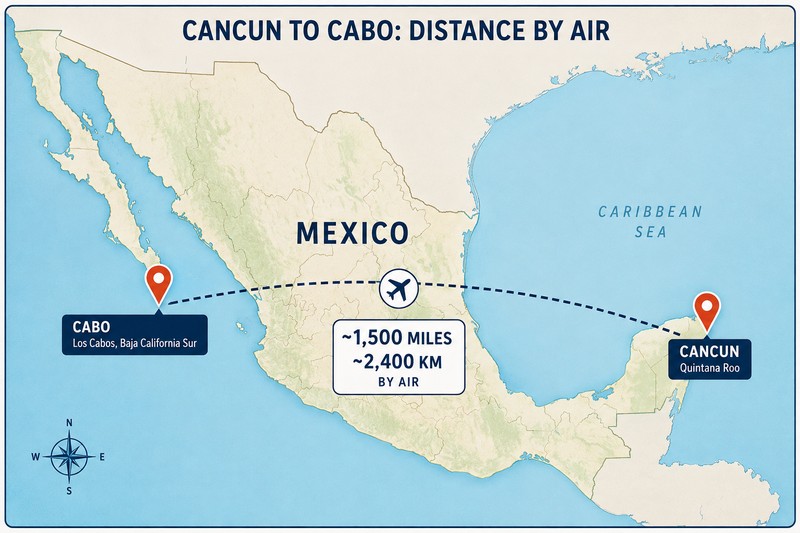
Created by AI
According to Allianz Partners 2026 data analyzing 1.3 million US traveler itineraries, Cancun ranks #1 and San Jose del Cabo ranks #2 as international spring break destinations for American college students. That gap in crowd size shapes everything from resort pricing to nightlife density: Cancun’s spring break infrastructure is built to handle tens of thousands of students simultaneously, while Cabo’s scene is concentrated around Medano Beach and a smaller downtown strip.
The Los Cabos Corridor — the resort strip running between Cabo San Lucas and the quieter town of San Jose del Cabo — gives Cabo travelers two distinct modes: high-energy party at Medano Beach, or boutique bars and rooftop venues in downtown San Jose del Cabo. Cancun offers a third emerging option in Costa Mujeres, a quieter area north of the Hotel Zone that some groups use as a calmer base while still day-tripping into the main strip. These are not interchangeable destinations — they offer fundamentally different landscapes, crowds, and vibes.
Nightlife Comparison: Which Destination Hits Harder
Cancun Nightlife
Cancun’s Hotel Zone contains three of the largest nightclubs in Mexico — Coco Bongo, Mandala Cancun, and HOF — all within walkable distance of each other and from most Zona Hotelera resorts. Coco Bongo is a multi-level arena-style venue known for live acrobatics and DJ sets running past 5 AM. During spring break, Cancun also hosts Spring Sounds, billed as the world’s largest spring break music event, which draws headlining DJs and is exclusive to Cancun among major Mexican destinations. Foam parties, theme nights at resort pool decks, and catamaran booze cruises round out the daytime-to-dawn event calendar that makes Cancun the default choice for groups whose primary goal is high-volume nightlife.

Cabo Nightlife
Cabo San Lucas’s nightlife centers on El Squid Roe, Mandala Los Cabos, and Mango Deck — the last of which functions as the anchor of Cabo’s spring break day-party scene directly on Medano Beach. Cabo Wabo Cantina, opened in 1990, remains a landmark venue on the main strip of downtown Cabo San Lucas. The key logistical difference from Cancun: Cabo’s downtown clubs (El Squid Roe, Mandala Los Cabos) are separated from Medano Beach resort hotels, requiring a taxi that typically costs $15–$25 per person per ride. Over a 5-night trip with multiple late nights, that taxi cost adds $75–$150 per person — a budget impact that most competitor articles on Cancun vs Cabo nightlife fail to quantify.
Verdict: Cancun hits harder on nightlife density, walkability, and large-scale events. Cabo offers a more spread-out scene that suits groups who want a mix of beach parties and bar-hopping without the mega-club intensity.
Beaches Side by Side: Swimming, Scenery, and Conditions
Cancun Beaches
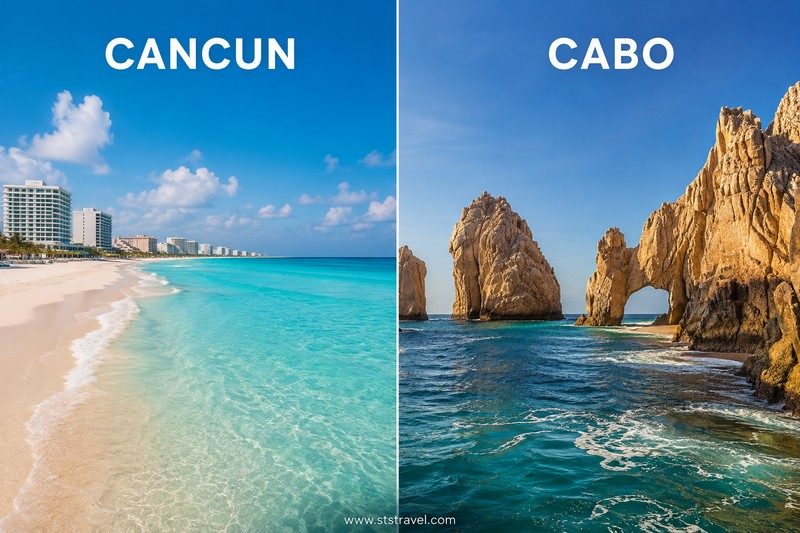
Cancun’s Hotel Zone beach runs along the Caribbean Sea, which produces the calm, turquoise, swimmable water that most travelers picture when they imagine a Mexican beach. The water along the Zona Hotelera is generally safe for swimming throughout the spring break season. The one genuine caveat for Cancun beach planning is sargassum seaweed: Cancun beaches are affected by sargassum influxes primarily between April and October, meaning March spring break departures typically encounter clear beaches, while groups traveling in early April face a higher (though not guaranteed) risk of seaweed on the shore.
Cabo Beaches
Cabo San Lucas’s only reliably swimmable beach in town is Medano Beach, a curved bay protected from the Pacific’s stronger currents. The majority of beaches in and around Cabo San Lucas — including those on the Pacific Ocean side — carry red-flag or no-swimming warnings due to strong rip currents and unpredictable swells. The Sea of Cortez side of the Baja Peninsula offers calmer water at certain beaches further from downtown. Cabo’s visual landmark, Land’s End / El Arco — the natural rock arch at the peninsula’s tip — is best seen from a boat rather than by swimming, as the currents around it are not safe for recreational swimming.
Practical note: For groups whose definition of spring break requires daily ocean swimming, Cancun’s Caribbean beaches are more consistently swimmable across the full resort strip. Cabo’s beach experience is more concentrated and requires knowing which beach is actually safe.
How Much Does Spring Break Cost in Cancun vs Cabo
| Item | Cancun | Cabo |
| All-inclusive package (5 nights, per person) | $900–$1,200 | $1,300–$1,800+ |
| Roundtrip flights (US average) | $350–$700 | $450–$1,000 |
| Estimated total budget (per person) | $1,200–$1,500 | $1,700–$2,300 |
| All-inclusive availability | Wide — most Zona Hotelera resorts | Available but fewer options |
| Group discounts (10+ travelers) | Yes — often includes group leader free-trip incentive | Yes, but less commonly structured |
The cost gap between Cancun and Cabo spring break is most visible in the all-inclusive package pricing. Cancun’s Hotel Zone has one of the highest concentrations of all-inclusive resorts in the world, which creates price competition that keeps 5-night packages in the $900–$1,200 per person range when booked through a spring break operator like STS Travel. Cabo’s all-inclusive inventory is thinner, and resort pricing reflects a more upscale market — equivalent 5-night packages run 30–50% higher than Cancun for comparable amenities.
For groups of 10 or more travelers, the math shifts further: group booking structures typically unlock per-person discounts, and most spring break operators offer a free trip for the group organizer once the group hits a minimum headcount threshold. A group of 5 choosing Cancun over Cabo saves approximately $1,500–$2,500 in total package costs — enough to fund a private cenote tour, a catamaran day trip, or a hotel room upgrade for the whole group.
Booking tip: Mid-week flights to both destinations run $100–$200 cheaper than weekend departures. Booking by November for March travel typically secures the lowest per-person all-inclusive rates before resort inventory in the highest-demand categories fills up.
Best Resorts for Spring Break in Cancun and Cabo
Many resorts in Cancun and Cabo will not accept Spring Break groups, including Hard Rock, Palace Resorts, Royalton, Breathless and Hyatt. Following are top resorts that are Spring Break friendly.
Top Cancun Resorts for Spring Breakers
Grand Oasis Cancun is one of the most affordable all-inclusive options in the Hotel Zone and is specifically popular with budget-focused spring break groups. Known for poolside DJ’s and a beach club that hosts top international DJ’s during Spring Break.
Riu Cancun is located in the hotel zone within a short walk to Nightclubs and shopping. This property is adults only (over 18) which means you wont have to share the pool with families and small kids creating a better party scene.
Riu Caribe combines all-inclusive food and drinks with poolside entertainment and a beach with calm waters. This resort is also home to the Riu Theme Parties.
Top Cabo Resorts for Spring Breakers
RIU Santa Fe Cabo is the most student-friendly all-inclusive property in Los Cabos — this large resort offers 4 swim up bars – 3 overlooking Medano Beach. With over 1,400 rooms this property is a Spring Break destination unto itself.
Pueblo Bonito Rose is notable specifically because of its walking distance to El Squid Roe and downtown Cabo clubs — a meaningful advantage for groups who want to avoid paying $15–$25 per-person taxi fares each night.
ME Cabo sits directly on Medano Beach and targets a younger demographic with a style-forward design and beach-party programming.
Things to Do Beyond the Party
Cancun Activities
Cancun’s location in the Riviera Maya corridor puts some of Mexico’s most significant cultural and natural attractions within a 1–3 hour drive of the Hotel Zone. The most popular day trips from Cancun for spring break groups:
- Chichen Itza — one of the New Seven Wonders of the World, approximately 2.5 hours from Cancun
- Cenote swimming — natural freshwater sinkholes in the Yucatan Peninsula’s jungle, accessible as a half-day trip
- Isla Mujeres — a small island 30 minutes by ferry, known for calm water and a relaxed atmosphere
- Xcaret eco-park — a large nature-and-culture theme park 45 minutes south of Cancun
- Cancun Underwater Museum (MUSA) — 500+ submerged sculptures snorkeled or glass-bottom-boated over in Cancun’s lagoon
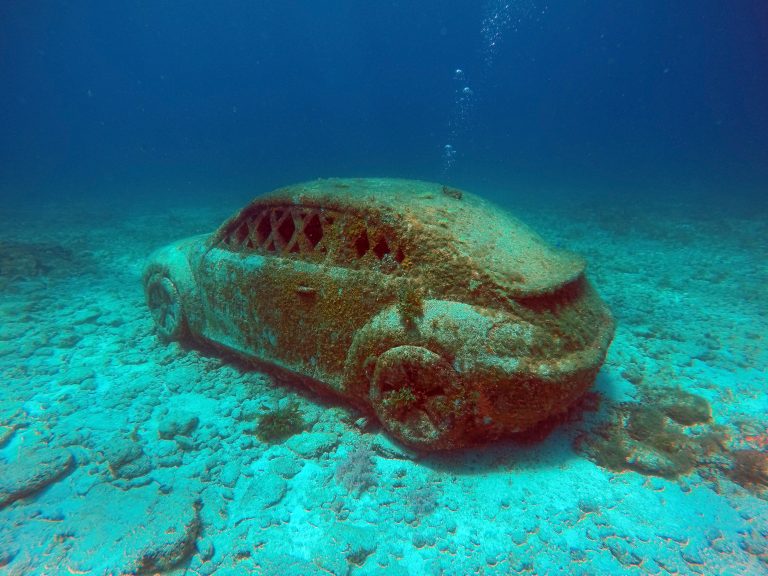
Cancun Underwater Museum (MUSA), By: Jamie Madden. CC0 licensed.
Cancun’s cenotes represent a type of natural environment with no equivalent in Baja California — swimming inside an ancient cave system lit by shafts of natural light is the kind of experience that stands out regardless of what else happens on the trip.
Cabo Activities
Cabo San Lucas’s Baja desert setting offers a completely different excursion profile — adventure-focused rather than cultural. The most distinctive day-trip activities from Cabo:
- Boat tours past El Arco (Land’s End) — a 1-hour trip to see the natural rock arch and sea lion colony at the peninsula’s tip
- Whale watching — gray whale and humpback whale season runs December through April, meaning spring break travelers catch the tail end of peak season
- ATV desert excursions — off-road quad tours through Baja’s coastal desert terrain
- Snorkeling at Cabo Pulmo — a UNESCO-protected coral reef 1.5 hours east of Cabo San Lucas, one of the healthiest coral ecosystems in the Eastern Pacific
- Sportfishing — Cabo San Lucas is one of the world’s top sportfishing destinations, with marlin and tuna charters available year-round
Cabo’s El Arco boat tour and whale watching are natural spectacles with no equivalent anywhere else on this trip list — these are experiences specific to the tip of Baja that a Cancun itinerary cannot replicate.
How to Get There: Flights, Airports, and Logistics
Getting to Cancun
Cancun International Airport (CUN) is one of the most connected airports in Mexico for US travelers, with direct flights from over 50 US cities. From East Coast and Midwest departure points — New York, Chicago, Atlanta, Dallas — Cancun is typically a 3–4 hour direct flight with roundtrip airfare averaging $225–$300. The airport handles high spring break volume with dedicated terminal areas, and pre-arranged transfers from the airport to Hotel Zone resorts take approximately 25–35 minutes.
Getting to Cabo
San Jose del Cabo Airport (SJD) has fewer direct US routes than CUN, with the strongest connectivity from West Coast cities: Los Angeles, San Diego, Phoenix, and San Francisco are approximately 2–2.5 hours from SJD. From the East Coast or Midwest, the same trip to SJD typically involves a connection and takes 5–6 hours total, with roundtrip fares averaging $300–$500. This means your home city often determines which destination is actually affordable — groups flying out of California or Arizona can reach Cabo faster and cheaper than Cancun, reversing the usual cost comparison.
Practical pre-trip checklist for both destinations:
- A valid US passport book is required — a passport card does not work for international air travel to Mexico.
- Book a pre-arranged airport transfer through your resort or travel operator rather than accepting unofficial taxi offers at arrivals.
- Travel insurance with medical evacuation coverage is strongly recommended; standard domestic health insurance typically does not cover international medical costs.
- Uber operates in Cancun’s Hotel Zone and can be used as a backup — Cabo does not have reliable rideshare app service.
Is Cancun or Cabo Safer for Spring Break
Both Quintana Roo (Cancun’s state) and Baja California Sur (Cabo’s state) carry a US State Department Level 2: Exercise Increased Caution travel advisory. Level 2 is the same rating applied to France, Italy, Germany, and the United Kingdom — it reflects standard awareness-level caution, not an active danger warning. Neither Cancun nor Cabo is meaningfully safer or more dangerous than the other based on this advisory, and both are distinct from the Level 4: Do Not Travel states such as Guerrero, Sinaloa, and Tamaulipas, which cover different regions of Mexico entirely.
The risks most relevant to college-age spring breakers specifically is to use common sense. Traveling in groups, have one friend stay sober to monitor everyone else. Common sense includes: never leave a drink unattended, do not accept drinks from strangers, and stay with your group when moving between venues.
Mexico strictly enforces its drug laws, and possession can result in detention — the consulate cannot prevent legal proceedings under Mexican law if you are arrested. The US Embassy recommends registering with the STEP (Smart Traveler Enrollment Program) at step.state.gov before departure, which allows the embassy to contact you in an emergency.
Vaping devices (e-cigarettes and vape pens) are illegal to bring into Mexico — customs confiscation and fines exceeding $10,000 apply. This is one of the most commonly overlooked pre-travel rules for college spring breakers and is not prominently featured in most destination comparison articles. Illegal drug laws in Mexico are enforced with strict penalties; Mexico does not share the decriminalization policies that some US states have adopted.
For Cancun specifically, the Guest Assist app is recommended by the US Embassy in Quintana Roo for emergency communication. Tourist police maintain a visible presence in the Cancun Hotel Zone, and Mexican National Guard patrols cover the main resort strip. For both destinations, staying within the hotel zone or resort area — particularly late at night — significantly reduces exposure to the risks that have affected travelers in non-tourist areas.
For parents: The key facts are that both Cancun and Cabo are actively policed tourist zones with Level 2 advisories (equivalent to Western Europe), that the most serious risks are behavioral rather than environmental, and that booking through a structured spring break operator that provides airport transfers and resort-based itineraries removes the most common decision points where things go wrong.
FAQ: Quick Answers Before You Book
Is Cancun or Cabo better for spring break?
Cancun is the stronger pick for groups prioritizing maximum nightlife, all-inclusive value, and a tight budget — 5-night all-inclusive packages in Cancun start around $900 per person. Cabo is the better fit for groups that want a mix of beach, adventure activities, and a slightly more upscale atmosphere, and are willing to spend 30–50% more per person to get it.
Is Cabo more expensive than Cancun for spring break?
Yes. Cabo spring break all-inclusive packages typically cost 30–50% more per person than equivalent Cancun packages. Roundtrip flights to San Jose del Cabo Airport (SJD) average $300–$500, compared to $225–$300 for Cancun (CUN). The total per-person budget for a 5-night Cabo spring break runs $1,700–$2,300 vs. $1,200–$1,500 for Cancun.
Is Cancun or Cabo safer for spring break?
Both destinations carry an identical US State Department Level 2: Exercise Increased Caution advisory — the same level as France and Italy. Neither is significantly safer or more dangerous than the other. The most relevant risks for spring breakers at both destinations are drink tampering, counterfeit pills, and unofficial taxis — not general crime rates in the resort zones.
How far is Cabo from Cancun?
Cancun and Cabo San Lucas are approximately 1,500 miles (2,400 km) apart by air, located on opposite coasts of Mexico. Cancun is on the Caribbean coast; Cabo is at the tip of the Baja California Peninsula on the Pacific side. You cannot visit both on a single spring break trip — they require separate flights and itineraries.
Is Cabo near Cancun? Is Cabo in Cancun?
No. Cabo San Lucas and Cancun are separate cities in different Mexican states, roughly 1,500 miles apart. They are not adjacent, not accessible by short drive or bus, and not part of the same tourism region. Choosing between them requires choosing a different coast of Mexico entirely.
Do you need a passport for spring break in Cancun or Cabo?
Yes. A valid US passport book is required for air travel to both Cancun and Cabo. A US passport card is not accepted for international air travel. Apply or renew at least 6–8 weeks before departure to account for processing times.
What is the drinking age in Cancun and Cabo?
The legal drinking age in Mexico is 18, which applies at both Cancun and Cabo San Lucas. US ID is typically accepted at resorts and clubs in both destinations, though individual venues set their own policies.
Which is better for a small group vs. a large group?
Cancun’s group discount structure favors larger groups: operators typically start applying group rates at 4+ travelers, with a free trip for the group organizer at higher headcounts. Cabo is more suitable for smaller groups (2–4 people) who prioritize quality over per-person savings, as the resort and excursion options work well at smaller group sizes without requiring a minimum headcount.
Can you do both Cancun and Cabo on one spring break trip?
No. Cancun and Cabo are 1,500 miles apart on opposite coasts of Mexico, and connecting between them requires flying through a hub city. A typical spring break trip is 5–7 nights — splitting that time between two destinations is not practical and would significantly raise the overall cost while reducing the experience at both.
Book Your Spring Break with STS Travel
Now that you know which destination fits your group, the next step is locking in your spot before prices rise. STS Travel offers all-inclusive spring break packages to both Cancun and Cabo San Lucas, with group discounts starting at 10+ travelers and a free trip for the group organizer when your headcount qualifies. Payment plans let you reserve your place with a deposit and pay the balance over time — which means early booking does not require paying everything upfront. Spring break resort categories in Cancun sell out by fall; flights to Cabo from West Coast cities fill especially fast. Book your spring break package with STS Travel and secure your rate before the price tier changes.